I have received some feedback suggesting I should do more “beginner” posts about guitar tone and effects. I have also noticed some interesting questions in the google keywords leading to this site. One grabbed my attention: “What is the difference between the Satchurator and the Ice 9 overdrive?”. These two pedals are designed by VOX in collaboration with Joe Satriani and the answer is: the Satchurator is a distortion whereas the Ice 9 is an overdrive.
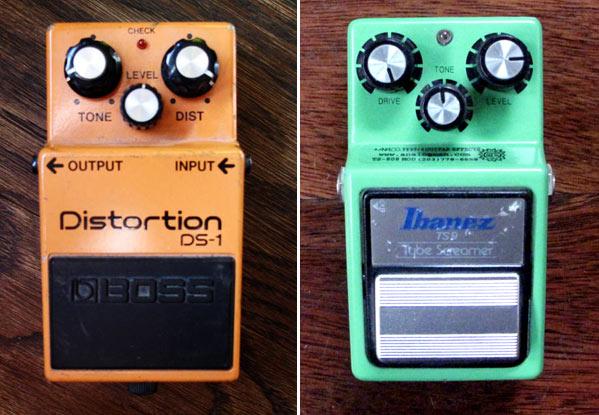
So what is the difference between a distortion and an overdrive? To put it simply, an overdrive pedal aims at simulating the creamy sound of an overdriven tube amp whereas a distortion does not try to simulate reality and usually offers more gain and is more aggressive.
The BOSS DS-1 distortion (left) and the Ibanez TS-9 Tube Screamer (right)
Way back in the sixties, the only way to get any kind of overdriven tone consisted in just cranking the volume of your tube amp to 10 or 11 if you could. And these amps had no master volume so they were really really loud. Fuzz pedals were the first attempt to reproduce this tone without having to crank your amp. They were really popular in the late sixties but they kind of missed the point and are really a different breed of effect. I will dedicate a post to fuzz pedals very soon!
Later on, talented electronics wizards invented “overdrive” pedals which provided a less harsh tone. Some of them truly approached the singing sound of an overdriven tube amp, so loved by blues and classic rock players. The Ibanez Tube Screamer released in the late 70s is an example of overdrive pedal which became really successful (see my post about it).
Around the same time, other wizards invented distortion pedals which generally offered a raunchier, dirtier, “gainier” tone. The BOSS DS-1 used a lot by Joe Satriani or the Proco Rat are two famous examples.
Then as they did before with fuzz pedals, guitarists combined the tube saturation of their amp with overdrive or distortion pedals, creating entirely new tones… but this is a story for later…
After Robert Smith and Jeff Beck, I thought it was time for some virtuoso action with the almighty Joe Satriani. If you don’t know who Joe Satriani is and you play the electric guitar, you probably have been abducted by Aliens in the 70s only to be returned to earth last week (go get “Surfing with the Alien” right now).
In this post we will look into his gear and learn how to recreate the same kind of lead tone using just a few common pedals that I will demo in a video. Although his studio albums – especially since the late 90s – feature a lot of different pedals and textures, Satch has a simpler approach on stage. 90% of the time, he uses the same recipe for his tone and the rest, as always, is in the fingers.
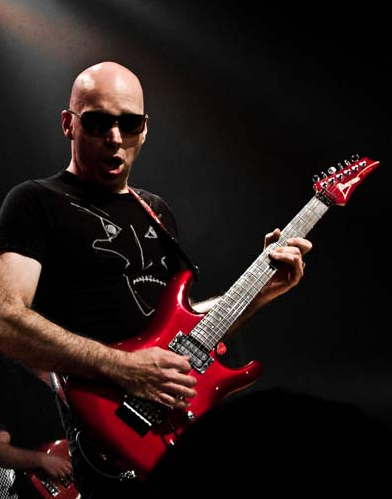
Photo by CodePoet taken on 2008-10-26 @ Variety Playhouse, Atlanta
Guitars
Although he played a Kramer Pacer on “Surfing with the Alien”, Satriani quickly became an Ibanez endorser in the late eighties and remains one today. His Ibanez signature JS family of guitars has not stopped growing. The “classic” workhorse model is the JS1000. There is a more affordable version named JS100 and more esoteric models like the newly released JS2400 with 24 frets or the JS1600 without tremolo. The JS1000 that he uses the most has a bolt on neck, 2 Di Marzio custom humbuckers and a floyd rose type of blocking tremolo system with fine tuners.
As such, it is very representative of 80s “guitar technology” after Eddie Van Halen took a Stratocaster-like guitar and put a humbucker and a floyd rose on it, making it a bit of a cross between a Fender and a Gibson. The pickups were specially designed for this line of guitars and I must say I especially like the neck pickup which has a very “glassy” almost Stratocaster-like quality. On the JS1000, the humbuckers can be split to sound like single coils, pretty versatile. The blocking tremolo system allows for much abuse and Satch is a great abuser, he can get the wildest effects out of it and still stay in tune.
Amps and Effects
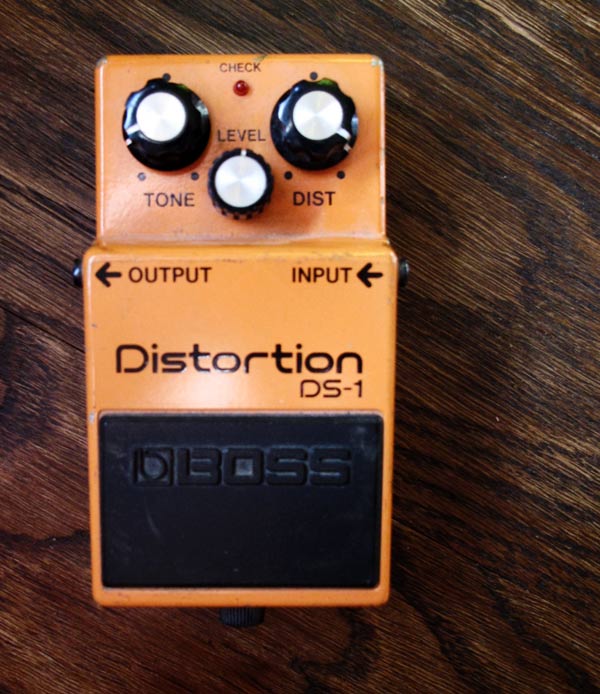
In the eighties, unlike many other fellow metal or rock guitarists, Satriani often did not get his big distortion tone from a super cranked Marshall boosted by some overdrive pedal. He used (and still does) distortion pedals in front of a clean amp. The BOSS DS-1 orange distortion was a very important part of his tone from the eighties all the way to about 2009 when his own VOX Satchurator distortion pedal was released. I went to his “Super Colossal” tour show in Paris in 2006 and I distinctly remember seeing him switching from clean to his signature lead tone by pressing on the little orange pedal in front of him. I am 99% sure it was a DS-1. This surprised me because it was not long after his own line of amplifiers (the Peavey JSX) had been released and there were quite a few behind him on stage. Although these amps are highly capable of providing lots of gain, he was obviously just using them clean and getting his distortion from the DS-1.
Now on the topic of the DS-1, it is loved by some and loathed by others. Some find it synthetic sounding or thin, etc. Let me tell you that it is not the kind of pedal that will sound great through any rig, it works well with some guitars and amps but can sound horrible used with others. Also, it does not have 100 sounds but one so if you love it, you’re in luck, if you don’t, you will be tempted to throw it out of the window. That said, a lot of pros use it and get great tones out of it and it has been in the BOSS catalog for over 30 years now! This controversial aspect of the DS-1 tone explains why it is one of the most modified pedals on the market. There are great mods by Analogman, Robert Keeley, Monte Allum, etc. It seems that in more recent years, Satriani was using a Keeley version (like his pal Steve Vai) although I am not finding any hard evidence of it. Update Feb 2012: in this awesome interview on musicplayers.com. Satch answers this question: “Well, I would use clean channel of the JFX. I’d get a slightly altered, vintage Boss DS-1. I can’t tell you the alteration, though, that’s a secret!“. That settles it but as far as what the alteration is, the question remains.
The BOSS DS-1 Distortion: love it or loathe it
It is funny to see that tone purists on forums are quick to qualify Satriani’s tone as bad, you know the “he should use a Les Paul 59 and a bassman from 1756 instead of an Ibanez and a cheap BOSS distortion” kind of remarks. Let me tell you that I have seen lots of great guitarists on stage and Satriani’s tone is one of the best I have heard. It really serves the songs and compliments his playing.
There are two other effects that are an important part of Satriani’s tone: delay and wah. He has used up to 3 delay units in series in the 90s. He has never been a fan of rack mounted gear and all his effects were usually pedals placed in front of him. The exceptions were two rack mounted chandler delay units that he would use on top of an old BOSS DM-2 analog delay or DD-2 digital Delay (see this guitar geek entry). His settings for the three delays were interesting: the first delay was quite short, the second delay longer and the third even longer. The blending of the three gives a very spacious tone. If you don’t have three delays you can try this with your favorite recording software, this sounds a bit like a reverb without using a reverb.
In the last decade, he went back to using one good delay pedal, often an old BOSS DM-2: see photos of his 2010 experience Hendrix tour pedal board. Of course, Satch now has his own delay pedal made by VOX, the Time machine. As to wah pedals, he used an old VOX model in the early days and a few years back he was using a Jim Dunlop 535Q, but he now has his own model made by… VOX: the Big Bad Wah. This is no coincidence that the first three pedals he designed with VOX are a distortion, a delay and a wah because these are the basics of his tone. An overdrive called Ice 9 has just been announced by VOX in the same range.
On the subject of amps, as I mentioned before, he rather uses them clean. In the 90s, he was using a Marshall Anniversary head and later on switched to his own line of Peavey JSX. Apparently, he is going back to Marshall after his short stint with Peavey.
To summarize, a good wah, a distortion and a delay plugged into a good clean amp is the basis for Satriani’s tone on stage. I am not saying that it is all you need to reproduce Satriani’s every tone, I am saying that this is the recipe for the lead tone he uses live about 90% of the time, especially on classics like “Surfing with the Alien”, “Satch Boogie”, “Ice 9”, and so on. Amongst the remaining 10% of the songs, some can be heavily reliant on one particular effect like the Digitech whammy used on “Cool #9”; the Electro Harmonix POG used on “Super colossal” for that super fat tone; or the Fulltone Ultimate Octave for several other numbers. I must also mention the use of modulation effects like a BOSS CH-1 chorus, a BOSS BF-2 Flanger or a univibe clone such as the Fulltone Deja Vibe. This is especially obvious on his clean tones although his pedal board has not been consistent in that respect. Pedals come and go with the different tours and albums.
Let’s redo Satriani’s Lead Tone
For this endeavor, I have used a RMC1 Wah pedal, a stock BOSS DS-1 distortion and a BOSS DD-3 delay plugged into my trusty Fender Silverface Champ set fairly clean. I don’t have an Ibanez-style guitar so I have used my Gibson SG 61 Reissue since humbuckers are a must for Satch’s lead tone (I accept donations in the form of JS1000s 😉 ).
A pity I don’t have a floyd rose kind of tremolo, I should not have sold my shredding guitar. If there is one thing that I have discovered, it is that Satriani has an extremely clean technique (emphasis on extremely clean) that my gruff style cannot match in a million years. Also, I am not able to reproduce the super smooth legato runs that Satriani is a specialist of as I am used to picking every note. Nevertheless I sure had lots of fun getting my old DS-1 out of the closet!
The settings were:
BOSS DS-1: DIST almost on max but not quite, LEVEL at 12 o’clock and Tone quite low at 8/9 o’clock
BOSS DD-3: LEVEL at 10 o’clock, FEEDBACK at 12 o’clock, TIME at 2 o’clock and MODE at 800ms.
On the amp: Volume at 3, BASS at 10 and Treble at 2.5 (the amp is fairly bright as a lot of fender amps are)
I don’t know what is happening but obviously the guitar is back. A number of big names are releasing or have just released ambitious albums.
First of all, Joe Bonamassa, who is an absolute guitar freak and has one of the biggest tones in Blues Rock has released just a few weeks ago an album entitled “Black Rock“. It sounds absolutely killer, after listening to it I feel like selling all my guitars on ebay. Here is the trailer for his Royal Albert Hall DVD released last year, the guy is 100% genuine, a real guitar lover:
Another big name, Slash, has just released his new album entitled Slash. It is full of guest singers and musicians such as Ozzy Osbourne, Chris Cornell, Fergie, etc. You can buy it and listen to it on www.slashonline.com. It rocks, it sounds big but is not overproduced, quite remarkable! It sounds a bit like Guns’n Roses recorded with 2010 technology.
Here is the trailer for the album:
And finally, Robben Ford and Michael Landau have teamed up for an album which should be released around now. It is entitled “Renegade Creation”. The myspace page of Michael Landau features some live footage of him playing with Mr Ford. For those of you who don’t know Robben Ford or Mike Landau, let’s say they are at the top of the heap of US session and stage guitarists. Their solo stuff is on the blues jazz fusion side of things and I am sure the album will be well worth a listen.
As a guitarist, sooner or later comes the question of the volume balance between rhythm and lead tones.
You probably all know the devastating feeling of playing the best solo of your life only to be told later on by members of the audience that nobody could hear it!
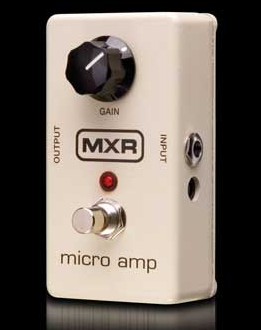
A nice affordable clean boost pedal: the MXR Micro Amp
In 2010, one could think this is a trivial problem but it is not. This is essentially due to the fact that a volume or gain modification anywhere in an effect chain can have a big effect on the overall tone. Unless you are a rock star and your sound engineer knows exactly when to boost your volume, there is a number of solutions to this problem that I will list in this post.
Using the guitar volume control or a volume pedal
The first solution that comes to mind is of course to use the volume control of your guitar. After all, why is there one? The problem is that reducing the volume of your guitar will reduce the amount of signal sent to your pedals and amp thus directly change the amount of distortion/overdrive in your tone. It can fit certain styles like blues rock where rhythm work is not as dirty as lead work. For instance, Jimi Hendrix made use of this extensively on stage: he could go from clean to dirty just by manipulating the volume of his guitar (note that the stratocaster is especially good for that). It also works well if you are more of a clean tone player. Using a volume pedal at the beginning of your chain is the same thing as using the volume of your guitar except it might be more progressive. You will have the same problem though: reducing the volume will reduce the amount of overdrive or distortion from any device placed after.
Using an amp with multiple channels
Another solution is to use an amplifier with 2 master volumes or 3 or more channels so that you can dedicate some of them to rythm work and some of them to lead work: usually these amps are not the cheapest and offer slightly different tones depending on the channel but they can be a good solution. For example, the high end models of the Marshall JVM series feature 2 master volumes and are programmable which makes them very flexible. Note that for those of you who need tons of distortion for their rhythm tone, a lot of 3 channel amps (especially those made in the 90s) won’t cut it since the middle channel is often tailored for crunch tones rather than devastating ones.
Using two overdrive/distortion pedals
This is a very flexible solution: you can set the volume of one pedal in “rhythm mode” and the one placed after in “lead mode”. In lead mode, you can have the two pedals together for more gain or just the lead pedal. It can be tricky to switch from rhythm to lead but it is doable especially with BOSS or Ibanez pedals which have a large switch. One stomp and you can switch off a pedal while switching on the other one. Combining two overdrive/distortion pedals is a broad topic in itself and I will soon post about it. A few recent distortion/overdrive pedals feature a “boost” switch to increase the volume for lead work, check out the Satchurator and the upcoming Ice 9 overdrive designed by VOX for Joe Satriani or the ZVEX box of rock.
Using a multi-effect unit or a modeling amp
Those of you with super sophisticated gizmos don’t have much of an issue since you can program rhythm and lead patches. They can even sound good plugged straight into a PA. This is not something that purists love but I have used my Line 6 Pod straight into a PA for gigs with very good results.
Using a clean boost or volume pedal at the end of your chain
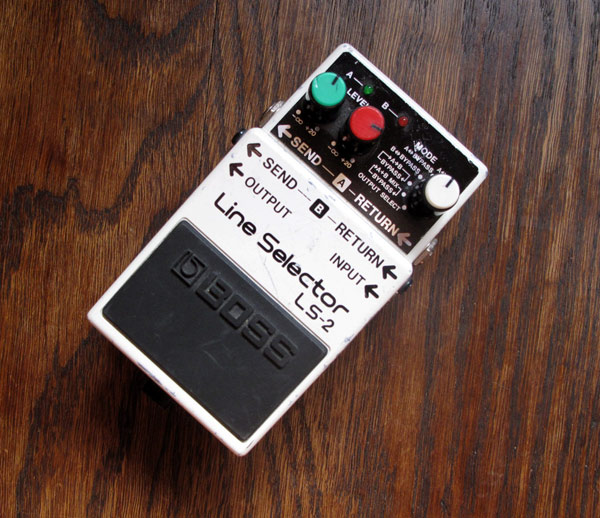
If you play against a clean amp and all your overdriven tones come from pedals, this is by far the easiest solution. A clean boost pedal will take the signal and make it louder without altering it. I personally use a BOSS LS-2. The LS-2 can also be used as a looper to switch between 2 chains of effects or use them in series, each chain having its own volume. I have heard the MXR micro amp is also pretty good placed after a chain of effects to increase the overall volume, not to mention all the boutique clean boost pedals. I stress that you need to have a clean amp with enough headroom because otherwise the extra volume might make the amp clip (which can also be a cool effect). Alternatively, most equalizer pedals feature a general volume control and will be able to get you a nice boost, check out the BOSS GE-7 or MXR 10 band EQ. And of course, you can also use a good old volume pedal but at the end of the effect chain rather than at the beginning as mentioned earlier in this post.
The BOSS LS-2 can act as a clean boost or a more sophisticated looper able to manage two effect chains each with their own volume
If your dirty tone comes from your amp, it is a bit trickier. People have had good results using a booster and or a volume pedal in the effect loop providing your amp offers such a facility. Be careful what kind of pedal you use. Most of them are OK but some of them won’t work in an effect loop since the signal strength is too different from a guitar output (check out the impedance). Check also that your effect loop has an adjustable level because in this case it will probably adapt to any pedal.
The beauty of this “end of chain” boost solution is that you can boost either your clean tone or your distorted tone which gives you a wide variety of tones for soloing.
Note that placed at the beginning of the effect chain, say right after your guitar, a clean boost pedal will have a different effect. If it is placed before a distortion/overdrive pedal, the more gain is dialed, the less the clean boost will have an effect on the overall volume, it will rather have an effect on the amount of distortion (this is because a side effect of distortion or overdrive is that the tone gets compressed). With a moderate amount of gain on your overdrive/distortion stompbox, a clean boost will fatten your tone and moderately increase the volume which is like going from the crunch to the lead channel on a 3 channel amp. As always when unsure, just experiment!
Conclusion
Solving the lead volume issue is linked to your style of playing and one or several solutions amongst those I have mentioned in this post might be available to you. And don’t forget that the volume is not everything and your tone will have to cut through the mix as I have explained in a previous post. Also you might want to check another one of my posts about the use of compressors at the end of your effect chain, it is a possible solution to boost your volume for solos although I have not always found it workable in live situations.