In Part 1 of this series of posts dedicated to modulation effects, I presented the Phaser. In Part 2, I will focus on an effect that has been around since the 60s: the Flanger also known as Flanging. We will see how it can be useful to us guitarists and in what style it is more prominently used. As always, I have prepared a few videos to demonstrate the Flanging effect, for which I have concocted some cool settings on my trusty Boss BF-2.

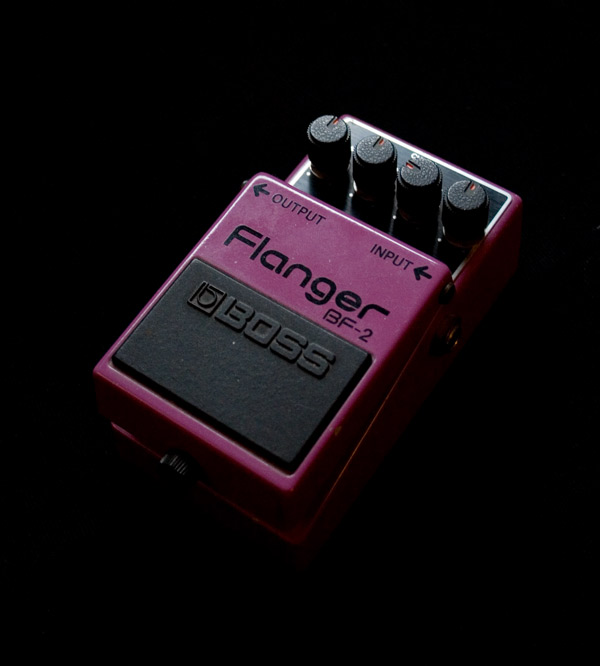
Now discontinued, the Boss BF-2 is a classic Flanger pedal - Photo by Pia Jane Bijkerk

How Flanger pedals came to be

The Flanging effect originated in studios in the sixties. It was generated by recording then playing back one piece simultaneously on two tape recorders. The result of the two tape recorder playback was recorded on a third tape recorder. Because the two tape recorders reading the piece were slightly out of sync, it created a phasing like sound. This could be emphasized by pressing on the “flange” or rim of one of the tape reel to slow down the playback. The delay between the two tape recorders would then be more pronounced and create a “jet plane” effect that came to be known as “flanging”. It was used at first to enhance whole mixes, the end of “Bold as Love” by Jimi Hendrix is the first example of stereo flanging in history.

Progress in electronics allowed engineers to recreate this effect without having to use bulky tape recorders and make units that could fit in a pedal. The trick used by Flanger pedals is to use a very short delay and some oscillator to slightly vary the delay time. Analog models use bucket brigade components, see my posts about delays for more information. Actually, if you set a delay pedal with a very short delay time, say 1 ms, you will start to get a hint of flanger effect but not as pronounced since there is no oscillation.

Settings

Most Flanging pedals have at least a Depth and a Rate or Speed knob. Depth sets the intensity of the effect whereas Rate sets the speed of the oscillation. The Boss BF-2 that I use in the videos below is more complex and has no less than four controls: Depth, Rate, Manual and Res. Res is a resonance setting which can be labeled as “regen” or “feedback” on other models. It controls how much of the processed signal is re-injected into the effect to get a more intense result. The Manual setting is specific to the BF-2 and apparently affects the amount of delay but I have no proof of that.

A generic word of advice for pedals which offer 4 or more settings since it can be overwhelming at first : try putting everything half way first, then adjust from there.

Clean tone and Flanger

Flanger pedals really became mainstream in the late 70s and were primarily used by rock guitarists. Before I show you how it sounds with a distortion, let’s see how it sounds with a clean tone.

If you are as old as I am, it should propell you right back to the early 80s and “new wave” bands such as The Cure or pop bands such as The Police. Flanging (and also Chorus) gave an ethereal quality to arpeggios and chords which suited their music perfectly. Both slow and fast rates are interesting in that respect as I demonstrate here . Note that it also suits funk rhythm licks:

Gear used for the video: Fender American Classics Custom Shop Stratocaster with Kinman AVn Blues pickups, 1974 Fender Champ Amplifier (Volume at 2, Bass at 10, Treble at 2.5).

A while back, I wrote a piece describing the tone of Robert Smith, The Cure’s guitarist and created this little rendition of “A Forest”, using a Boss BF-2 Flanger and a Boss DD-3 Digital delay:

Audio MP3

Distortion and Flanger: Before or After the Distortion?

As I wrote in my Phaser post, Eddie Van Halen used a phaser a lot but little is known that he also used a flanger to create some of his best tones. “Unchained” is probably his most recognizable Flanger tone. Queen’s Guitarist Brian May is also a big flanger fan, listen to “Keep Yourself Alive” for a fine example of tape flanging.

The Flanger effect is usually placed after overdrives and distortions in the chain but it can also be interesting to place it before, which is something that Prince does for instance. I will show you in coming videos the difference between the two placements.

First, here is how it sounds placed after the distortion. I show another three example settings using my BF-2. A bit of warning here, the BF-2 is a quite strong effect which also tends to boost the volume especially when the Depth knob is set past 12. Flangers, much like phasers, tend to create “volume” spikes by nature. The first setting is an example of how a low “Rate” (or speed of modulation) fattens the tone. Using higher speeds tend to create a wobblier effect that I think is not as fattening but almost resembles the sound of an organ:

Gear used for the video: Fender American Classics Custom Shop Stratocaster with Kinman AVn Blues pickups, 1974 Fender Champ Amplifier (Volume at 2, Bass at 10, Treble at 2.5), Analogman modded Boss DS1 Distortion (Dist at Max, Tone at 8 o’clock and Level at 10 o’clock).

And here is how it sounds placed before the distortion, the effect is less pronounced but a bit crazier at the same time. I think it is interesting to get an “out of control” tone:

Gear used for the video: Fender American Classics Custom Shop Stratocaster with Kinman AVn Blues pickups, 1974 Fender Champ Amplifier (Volume at 2, Bass at 10, Treble at 2.5), Analogman modded Boss DS1 Distortion (Dist at Max, Tone at 8 o’clock and Level at 10 o’clock).

Which model to choose?

There are a lot of Flanger pedals to choose from on the market, here is a short selection:

  • The MXR Flanger is one of the oldest flanger pedal designs around and has been reissued recently. Since Van Halen used it quite a bit, MXR has released an EVH model.
  • The MXR Micro Flanger was recently re-issued and packs a lot of good flanged tones in a tiny package.
  • The Electro Harmonix Deluxe Electric Mistress has been used by David Gilmour but also by Andy Summers. Rumour has it that what everyone thinks is a chorus in some of The Police’s clean tones is actually an Electric Mistress flanger.
  • The Boss BF-2 which I have demonstrated in this post is sadly discontinued but it is relatively easy to find on the second hand market as it was in production for 20 years (between 1980 and 2001). It is quite versatile and is especially great for early 80s new wave clean tones à la The Cure.
  • The Boss BF-3 has replaced the BF-2 in the Boss range. Although it is not clearly stated on the Boss website, I am pretty sure it is a digital pedal which gives it two rare particularities: it is stereo and there is a “tap tempo” feature to set the speed of the oscillation just by tapping a footswitch.
  • The Ibanez FL-9 is another classic 80s design which has been reissued. It gives a warm but high quality flanging tone and has its own personality. I personally own one and I will probably do a BF-2 versus FL-9 post. You can also spot it at around 4:35 in this video presenting the gear Joe Satriani has used on the Chicken Foot tour. Maxon, the manufacturer which used to make the Ibanez pedals in the 80s, has also an FL-9 reissue in its range. I could not tell you which one is better and/or more authentic.
  • Flanger is not huge on the “boutique” market but there are a few models, check out the Strymon Orbit or the T Rex Twister and Tonebug Chorus Flanger.
Share
 

There is a lot of effects that fall under the “modulation” category on the ground that they send your tone swirling or oscillating. In this series of posts, I will try to unravel the mysteries of  effects such as phaser, flanger, chorus, leslie/univibe, vibrato or tremolo. These effects, if used well, can spice up your rythm work or make your lead tone fatter to name only two of their magical powers. I will not go into too much details about the electronics behind these effects but will focus on their characters and uses for us, guitarists. Videos are included to stir up your inspiration.

In this first part, I will present one of the oldest modulation effects: the Phaser also known as Phasing or Phase-Shifting.

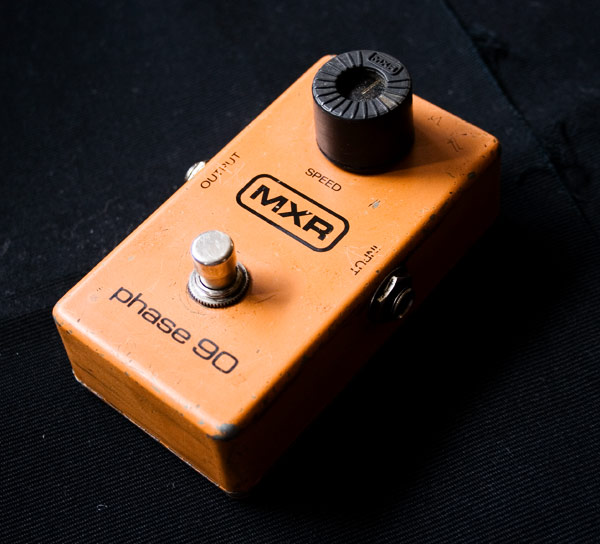
The MXR Phase 90, one of the most famous phaser pedals - Photo by Pia Jane Bijkerk

Phaser or Flanger?

The first thing I should clear up is the difference between phaser and flanger as I often see in forums that people get confused. Phasing is created by using a series of filters (all pass filters) associated with an oscillator whereas flanger is created by using a very short delay. I am over simplifying here but know that they do sound different. Phasing tends to sound a little “crazier” and has no real equivalent in the real world. Flanging, on the other hand, sounds like a jet plane taking off and is akin to a real world sound effect known as “Doppler”.  I will write about flanging in part 2 and focus on phasing in this post. For those of you wanting to know more about the science and the electronics behind our beloved phaser pedals, have a look at this wikipedia page.

Who uses a phaser?

The phaser effect is used in almost every genre but some are more phaser friendly than others.  Used with a non distorted clean tone, it is for instance very popular in reggae: listen to the solo of “No Woman No Cry” on the live at the Lyceum by Bob Marley for a prime example of phased guitar.

Funk is also a genre where phasing is king. It enhances rhythm licks and can be an alternative to a Wah (although they are two different things).

When it comes to big rock tones, Brian May of Queen and of course Eddie Van Halen are big phaser users. The first Van Halen album is almost a demo of  the MXR Phase 90, listen to the Intro of “Atomic Punk” or “Ain’t Talking about Love” and you’ll know what I mean.

Timeless Classics: the MXR Phase 90

You will find information about other models after the videos below but I have decided to present and demonstrate the MXR Phase 90 first. This little orange pedal is to phasers what the Tube Screamer is to overdrives: the standard. I have recently acquired a vintage phase 90 and I must say the hype is not unfounded. It is really warm and although it has only one setting (“speed”), you can get a lot of different sounds out of it. With the speed setting between 10 o’clock to 12, it goes straight into Van Halen territory whereas at higher speeds, around 2 o’clock, it is reminiscent of some tones Hendrix got with his univibe pedal.

If you are in the market for a Phase 90, it can get confusing as there are several models to choose from. The very first 1970s unit had no LED and “Phase 90″ was written using a type of “handwriting” imitation. Thus, these pedals are nicknamed “Script”. Around the end of the 70s, the lettering changed to capital letters and these models are nicknamed “Block”. The sound did not change much between these two early versions though.

MXR went bust in the 80s and the brand was resuscitated by Dunlop. No less than three versions of the Phase 90 are currently manufactured by MXR. The entry model, orange with a LED and “Block Lettering” is the most affordable. The thing is it does not sound quite like the old stuff and tends to provide a more “pronounced”, less subtle phasing effect. In order to address these issues, MXR also sells a reissue model which sports a “Script” logo and has no LED or external power plug. It does sound more subtle and is closer to the old 70s models.

The third model in the range, the Eddie Van Halen or EVH Phase 90 has a little switch to go from a modern “Block” tone to a more subtle vintage “Script” sound. A fourth custom shop model was sold until recently, it was orange, with Script lettering and a led and its model number is CSP-101. People who have opened it apparently found out that it was an EVH model without the block/script switch which seems quite redundant to me and might explain why it seems difficult to find it anywhere. For a sound comparison between the entry level “Block” Phase 90 and the Custom Shop “Script” model, have a look at this video by gearmanndude.

Phase 90 Video Demos

Here are three videos showing my Vintage MXR Phase 90 in action: first clean then placed before the distortion and finally after the distortion. I show different settings in each video and at the end, I add a little delay using my Boss DD-3 to show how it plays with a phaser for an ultra spacious tone.

Phase 90 with fairly clean amp first:

Gear used for the video: Fender American Classics Custom Shop Stratocaster with Kinman AVn Blues pickups, 1974 Fender Champ Amplifier (Volume at 3, Bass at 10, Treble at 2.5).

And now placed before a distortion. Note how the 10 o’clock speed setting is very Van Halen-esque whereas the 2 o’clock setting goes into Hendrix territory:

Gear used for the video: Fender American Classics Custom Shop Stratocaster with Kinman AVn Blues pickups, 1974 Fender Champ Amplifier (Volume at 3, Bass at 10, Treble at 2.5), Analogman modded Boss DS1 Distortion (Dist at Max, Tone at 8 o’clock and Level at 10 o’clock).

Finally, here is how it sounds placed after the distortion. Note how more pronounced the effect is. I personally prefer to place it before the distortion:

Gear used for the video: Fender American Classics Custom Shop Stratocaster with Kinman AVn Blues pickups, 1974 Fender Champ Amplifier (Volume at 3, Bass at 10, Treble at 2.5), Analogman modded Boss DS1 Distortion (Dist at Max, Tone at 8 o’clock and Level at 10 o’clock).

Alternatives to a Phase 90

There are other models than the MXR Phase 90 but before you choose a phaser pedal, you have to know that phasers have a certain number of “filter stages” (remember, phasers are built using a series of filters). The number of stages has a great influence on the tone. In some ways, the more stages, the more pronounced the effect. Basic phasers such as the recently reissued MXR Phase 45 have only two stages and they are quite gentle. 4 stage phasers are the most commonly heard on records, uber famous examples are the MXR Phase 90 or the Electro Harmonix Small stone, both used by David Gilmour in the 70s. If you want that classic 70s phaser tone, chances are you will want a 4 stage phaser.

Companies like Boss went further with their phasers and the now discontinued PH-2 had 10 or 12 stages depending on the position of its mode button.  I own a PH-2 and although it is not a bad phaser, it tends to sound quite out-worldly and I find difficult to use it to reproduce the Van Halen rock tone or the cleaner reggae/ 70s funk tone. The replacement of the PH-2 in the Boss line, named PH-3, is a digital pedal and can emulate the tone of 4, 8, 10 and 12 stage phasers. I haven’t tried it but I gather from various sources that it is versatile if not very warm sounding.

The settings on a phaser can go from only one speed button (MXR Phase 90 or 45) which decides how fast the tone “swirls” to three knobs called Depth, Rate an Resonance (Boss models). Depth is the ratio between processed and unprocessed sound, Rate is the speed of the oscillations and Resonance is a setting that allows to take some of the processed signal and send it back to be phased again which creates super crazy effects.

There is a bit of a debate as to where to place a phaser in the effect chain. In most multi-effect units, it is placed after the overdrive/distortion stage but I must say that I got very good results by placing my Phase 90 before a distortion as seen in the videos above. As always, experiment!

Let’s also not forget that phasing sounds great with keyboards, especially with Fender Rhodes electric piano sounds as well as pads. It even sounds good with bass! If you lend your phaser to your keyboardist or bassist, he/she might not want to give it back, you are warned!

Other noteworthy phaser models

On the second hand market, another great model is the Maestro PS-1, good luck to find one. As far as I know there is no clone on the market.

Boutique manufacturers have also come up wit great models such as the Retro-sonic Phaser which is an MXR Phase 90 clone with more settings. Let’s also mention the Pigtronix EP1 which is as whacky as it gets.

Finally, for those on a budget, the Ibanez PH7 is a good alternative with 4 and 8 stage modes.

Share
 

In Part 1 of this series of posts dedicated to the use of delay, I have shown how to create rhythmical effects “à la U2″ by synchronizing the delay to the tempo of a song.  Today, in Part 2, I will first give you a few example settings showing how to fatten your tone using a Boss DD-3 and an Electro Harmonix Deluxe Memory Man. After the videos, I will explain the differences between analog and digital delays as they both have distinct sounds and when it comes to choosing a delay pedal, the analog versus digital debate is still very much alive!

Fattening your tone: the “guitar hero” delay effect

Here is a personal favorite of mine, the type of delay that countless 80s guitarists used pretty much all the time to season their fierce solos. I have reproduced it using a Digital Boss DD-3 as well as an Analog, darker sounding Electro Harmonix Deluxe Memory Man:

Gear used: American Classics Stratocaster with Kinman pickups -> Analogman TS9 -> Proco RAT 2 -> Marshall JMP-1 preamp plugged direct into the recorder

To recreate this type of delay using a software plugin or multi-effect, set a delay time around 350 ms, 3 or 4 repetitions and a mix level of about 25%. Results may vary depending on your exact equipment. As always, experiment to find out what you are most confident with and most importantly what the song you are working on exactly needs.

Fattening your tone: the slapback echo

I have written a complete post about it so I will only give the audio examples here. The slapback echo is the “mother of all delays”. It consists of only one short repetition. As simple at it may seem, it is a very effective tool as shown in this video:

Gear used: 78 Telecaster -> Proco RAT 2 -> Fender Champ

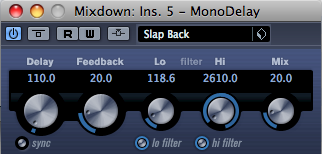
In the video, the slapback delay is generated using Cubase 5′s delay plugin with the following settings:

Slapback Settings

You can achieve the same type of tone with a Boss DD-3 and the following settings: Mode 200ms, E.LEVEL at 12 o’clock, F.BACK at 9 o’clock and D.TIME at 4 o’clock. You might want to vary the E.LEVEL or D.TIME to taste. It is easy to reproduce this effect with any other model of delay, just set the “delay time” between 70 and 200ms and the “feedback” quite low in order to have just one repeat.

Fattening your tone: Multitap delays

When one delay is not enough, use several of them! Known as “Multitap Delay”, the use of two or more delay units multiply the possibilities. Here I show the Boss DD-3 and the Electro Harmonix Memory Man together. Note that I had to reduce the delay time on the DD-3 compared to the first video, reason being that the previous settings were too close to the Memory Man and did not create enough of a swirl:

Gear used: American Classics Stratocaster with Kinman pickups -> Analogman TS9 -> Proco RAT 2 -> Marshall JMP-1 preamp plugged direct into the recorder

Again experimenting is the key here. I have used two delay settings that were quite similar but you can also use two delays with very different settings like a short one and a long one. At some stage, Joe Satriani was using three delays at once: one with a short delay time, another one with a medium delay time and a third one with a long delay time. It gave his tone almost a reverb like feeling.

The Analog vs Digital Debate

After seeing these demos you might want to go shopping for a delay pedal and must be wondering: “analog or digital?”. We have to go back in time in order to understand why there are several types of delays on the market.

Continue reading »

Share
 

The delay is a favorite effect of mine. I remember the first time I tried one, I thought I was David Gilmour for a minute.  It is probably one of the most useful effects out there. It offers a world of possibilities but it usually requires some practice to master. I will explore the main uses of a delay in a series of posts. Part 1 is dedicated to the creation of rhythmic patterns using a delay and we will see how to recreate the basic “U2″ delay effect. Later, in Part 2, we will focus on the ability of this fabulous effect to fatten your tone and discuss the differences between analog and digital delays.

The Electro Harmonix Deluxe Memory Man Analog Delay and the BOSS DD-3 Digital Delay, two very popular models

The Basics

What a delay does is repeat the notes you are playing on your guitar once or several times, each repetition being usually softer than the previous one. You encounter a similar effect in nature when shouting in a valley or a cave. The time between the repetitions can be chosen through a “delay time” setting on most units. It is usually labelled in milliseconds and ranges from a few milliseconds to several seconds for the most sophisticated models. The number of repetitions is usually defined by a “feedback” setting. Most units also offer a “level” or “mix” control which determines the amount of dry signal versus the delayed signal. Often, delays are also called echos. There is a difference though: delays can have an infinite number of repetitions whereas echos have a limited number.

To clarify, a delay unit should at least offer three settings: delay time, feedback and mix/level. More recently, delays have been incorporating many other settings which I mention further down.

Delay Time and Tempo

You will often read or hear that the delay time should be set according to the tempo of the song you are playing. I don’t think this is always true. If you are using the delay to obtain a rhythmical effect (think The Edge from U2 or Pink Floyd’s “Run like Hell”), then yes the delay time should follow the tempo of the song. But if you are using the delay to fatten your tone (as we will see in Part 2), I don’t think following the tempo of the song is so important.

Using the delay for rhythmical effects: the infamous dotted eighth

The Edge, U2′s guitarist, has made the use of rhythmical delay effects his trademark. In the beginning of  his career in the early 80s, he was already using a delay to make out as if he was playing more notes than he was actually playing. The trick was that the notes “played” by the delay were in sync with the tempo of the song which gave U2′s songs an amazing “pulsation”.

At the time, he was only using analog delays which means the settings had to be done “by ear” and that is not that easy. It also meant that the drummer had to play in sync with the delay. This led The Edge and U2 to drop the delay on their second album (“War”). It was of course back in full force on the subsequent albums on songs like Pride or Where The Streets Have No Name, probably helped by the arrival of digital technologies.

It is easier nowadays to get the same kind of effect using a digital delay unit or a software plugin which allows you to set the delay time to the millisecond. The basic “U2 delay effect” is obtained by setting the delay time to a “dotted eighth”. The feedback should be set so that you have about three or four repetitions and the level/mix quite high, at about 50%. Then, all you have to actually play are eighth notes, the delay will do the rest (see the audio examples below). Note that a dotted eighth is equivalent to 3/16th of a note.

Here is the formula to calculate the delay time so that it falls on a dotted eighth:

delay time in ms = (240000/tempo)x3/16.

Let’s take an example. At a tempo of 120 BPM, divide 240000/120, you get 2000. Multiply 2000 by three and divide by 16 and you get 375ms.

Here is an audio example at a tempo of 120BPM, WITHOUT any delay first:

Audio MP3

Then the exact same thing augmented by a delay set at 375ms, 3 or 4 repetitions and mix at 50% (I have used the delay integrated into my Boss MICRO-BR recorder with the feedback at 13):

Audio MP3

Pretty cool!

Some pedals spare you the cumbersome calculations and allow you to actually do this while playing alongside a drummer in real time, and without any prior knowledge of the tempo. They do so thanks to two extra features that most delay pedals don’t have: a “tap tempo” function and a setting that allows you to choose the delay time based on a “musical” subdivision (dotted 8th for instance). The Tap Tempo allows you to “tap” a pedal in time to set the value of the delay time “on the fly”.  So on these particular models, you can select “dotted 8th” and tap alongside your drummer and voilà, the delay should automagically be in time.

These models include the BOSS DD-20 Digital delay, the Line 6 Echo Park,the TC Electronic Nova Repeater or the super duper boutique high end Providence CHRONO DLY-4. A lot of pedals have got a Tap Tempo feature nowadays but not that many have the ability to select a “musical” subdivision. A note to BOSS DD-7 users: there are a few musical subdivisions (including dotted eighth) that can be selected using the mode selector, check out the manual.

Finally, know that the dotted 8th is not the only interesting subdivision, it is just one that has been used time and again on numerous hits. As always, feel free to experiment! There are two really cool websites you might want to check out if you are into using delays for rhythmical effects: this one by Tim Darling which deals with everything “The Edge” and this one by David Battino which is more generic.

In Part 2 of this series of posts, we will see how we can sound like a guitar hero by fattening our tone using a delay. Stay tuned!

Related Posts with Thumbnails
Share
© 2010 guitar TONE OVERLOAD Suffusion theme by Sayontan Sinha