As a follow up to two posts I wrote about the Reverb effect (see here and here), I thought that a demo of my good old Boss RV-3 was in order.

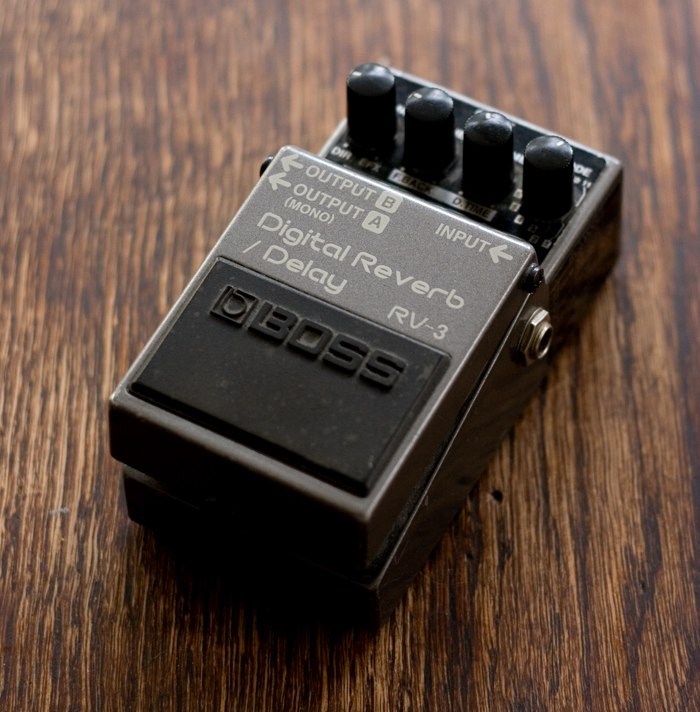
Boss RV-3 Digital Reverb / Delay - Photo Pia Jane Bijkerk

At some stage, you could spot the Boss RV-3 in the pedalboards of acts such as Mike Eizinger (Incubus) or Johnny Greenwood (Radiohead). Made between 1994 and 2002, the RV-3 is quite unique as it combines a digital delay unit and a digital reverb unit. I have included the detailed specs at the end of this post for more information on the different modes.

But before diving into the details, let’s hear it in action. I have recorded this video which shows my favorite settings followed by a demo of each of the 11 modes of the RV-3:


My thoughts on the RV-3

The Boss RV-3 is a product of the mid 90s. It doesn’t feature any analog delay or spring reverb simulations, this is a pure digital beast. Delays are crystal clear and reverbs are precise (some would say “metallic”).

That said, I find that its unique capability (for a compact pedal) to combine delays and reverb provides big “studio quality” guitar tones which can be reminiscent of Jeff Beck’s studio sound on his recent albums. It can also go into total spacious ambient territory and can be used with two amps for a stereo setup as it features one input and two outputs.

For all this, the RV-3 is quite underrated and is a great catch on the second hand market, watch out for one. The RV-5, which replaces the RV-3 in the Boss line up, features a spring reverb simulation on top of the digital kinds but does not have the delays of the RV-3. As such, I find hard to compare the two.

Detailed specs

The RV-3 has no less than 11 selectable modes. One knob selects the mode and the other 3 knobs have different functions depending on the chosen mode. In reverb mode, they affect the parameters of the Reverb: tone, time and level. In delay and delay+reverb mode, they affect the feedback (number of repetitions), delay time (time between the repetitions) and the effect level. Note that in delay+reverb mode, you cannot choose the amount of delay and reverb separately, the unique level knob will allow you to blend more or less delay and reverb, put together.

The modes are as follows:

4 Reverbs:

  • Plate reverb simulation: Hendrix and other late 60s acts were fond of plate reverbs to magnify their tones in the studio. This is quite a big sounding reverb
  • Hall: big digital reverb simulating the space of a rather large enclosed space
  • Room 2: a medium-short room reverb which can be used a bit like a spring reverb, knowing that the RV-3 has no spring reverb simulation
  • Room 1: a short reverb to add just that little bit of ambiance

4 Delay + Reverb modes:

  • Delay + Plate Reverb
  • Delay + Hall reverb
  • Delay + Room 2
  • Delay + Room 1

3 “pure” delay modes:

  • Short: 32ms – 125ms (great for slapback echo)
  • Medium: 125ms – 500ms
  • Long: 32ms – 1000ms

I have demonstrated all these modes in the video above, enjoy!

Share
 

As I have shown in the audio examples at the end of Part 1, a reverb unit can be used as an effect instead of a sound reinforcement tool. The main difference is that when you use the reverb as an effect, you usually want it to be heard as opposed to using it in a subtle fashion to add some depth to the sound. It is something that guitarists on the lookout for bigger tones have pioneered, thanks in large part to Fender whose amps often offered a built-in spring reverb. And let’s not forget their stand alone tube reverb unit which is an absolute classic.

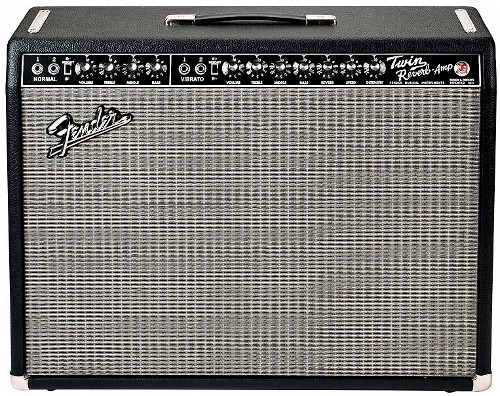
The Fender Twin Reverb, a classic example of amplifier with builtin reverb

Surf music wouldn’t have been quite the same without these Fender clean guitar tones laden with spring reverb. But listen to Stevie Ray Vaughan’s albums and you will hear quite some spring reverb as well. It shows that electric blues is another style where amp reverb is a common staple. Past spring reverbs, a classic example of studio reverb used partly as a sound reinforcement tool and partly as an effect is Voodoo Chile Slight Return by Jimi Hendrix. The wah wah intro is completely magnified by an EMT plate reverb.

The downside of reverb used as a live guitar effect is that it can be difficult to control in a venue, even a small one, because the venue itself will already have some natural reverb (see my previous post). It might make your tone really muddy which might be why, come the eighties and the advent of cheap digital delay pedals, most guitarists switched to using delays to widen their tone. It is not quite the same thing though and I can sense reverb pedals becoming popular.

Adding a Reverb to your Board

If reverbs have always been present in multi effect units, Boss was until about 10 years ago the only brand that offered a compact reverb pedal. Nowadays, there is a wide array of models on offer. Here is a short selection of reverb pedals :

  • Boss RV-5: Boss was the first company to manage to squeeze a digital reverb in a compact pedal. I personally own an RV-3 which can generate Reverb AND delay effects (I will make a demo soon). The RV-3 has been replaced by the RV-5 which has dropped the delays but has gained a spring reverb simulation among other things.
  • Electro Harmonix: the Holy Grail and its siblings have become immensely popular. They sport a luscious digital reverb as well as a spring reverb simulation.
  • The T-REX Room-mate is digital I suppose but it features a tube for added warmth.
  • The TC Electronic Tone Print “Hall of Fame” is the new kid on the block, here is a demo which shows you what you can do with a good reverb pedal (TC also offers the Nova Reverb) :

And finally, here is a demo of the Sole Mate and Reverbamate pedals from Vanamps. They are the only non digital/actual spring reverb pedals that I know of, for those of you who demand the real deal:

Share
 

I recently got a few comments asking why I use reverberation in post processing in some of my Youtube videos. In this series of posts, I would like to outline the two main uses of reverb for guitarists. In this first part, I will focus on the use of reverb in the studio and will explain why I sometimes add some light reverb to my videos. You will also find several sound examples. Part two will focus on the use of reverb as an effect.

Natural vs Artificial Reverb

In an enclosed space, any sound will bounce off the walls, thus creating a king of muffled echo. An extreme case of reverberation is found in cathedrals or caves where any sound can be reverberating for seconds. But even in a small space, you will get some reverberation. Try clapping in your toilet or bathroom and you will probably hear it. In a nutshell, a reverberation unit (commonly known as reverb) is an effect device which aims at reproducing this phenomenon. Reverberation is also sometimes referred to as “ambiance”.

Reverberation is almost as old as recording studios or radio stations. Sound producers and engineers had found out very quickly that recording any source (guitar, voice, etc.) using a microphone placed close to it lacked any sort of “ambiance” or “natural reverberation”, producing a quite unpleasant dry sound.

To solve that problem, a number of artificial ways to produce reverb were invented. The most primitive was to use a big empty room with a speaker at one end and a microphone at the other end to record the effect. Later on, spring and plate reverberation units were invented. Eventually, digital technologies became affordable and reverb units capable of simulating pretty much any space are now available as software plugins, pedals, rack effects, etc. I invite you to read the wikipedia page dedicated to reverberation for more information.

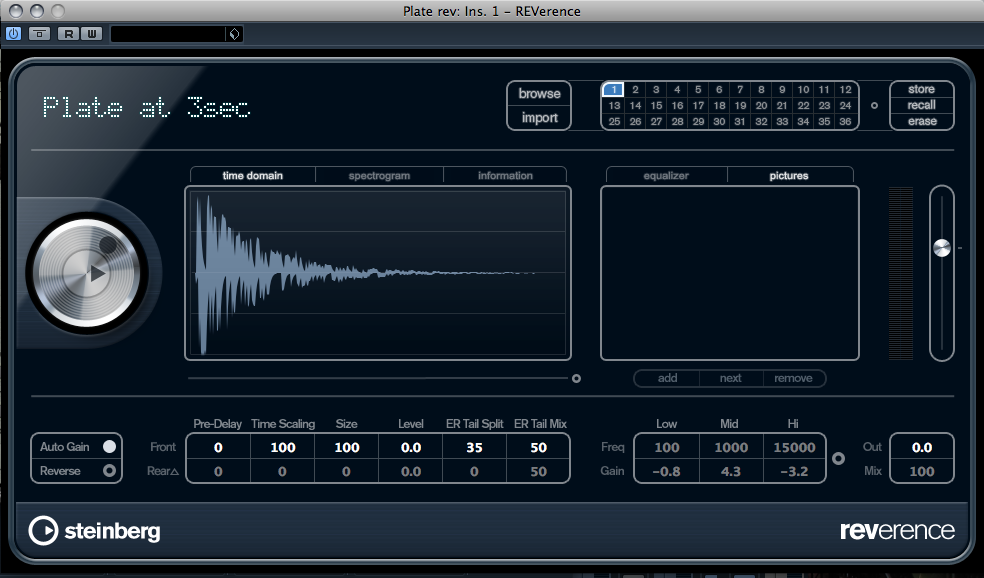
Reverence is a Cubase 5 reverb plugin which uses convolution techniques i.e it uses imprints from actual venues to generate reverberation

When I use a bit of reverb in my videos, this is not to “inflate” the tone, it is just because the microphone I use is close to my amp and misses out on the natural reverb of the room.  Short of adding some artificial reverb, you can change the microphone placement and put it further away from the amp in order to get more of the ambiance of the room, but you might pick up undesirable sounds. It is a matter of experimenting and finding the right spot.

Guitar and Studio Reverb Sound Examples

Here is a short distorted guitar clip. It was recorded by placing a microphone really close to my Fender Champ and no reverb was added. Note how dry it is:

Audio MP3

Here is now the same clip with a short room reverb (I have used the LA Studio preset of Cubase 5′s Reverence plugin):

Audio MP3

The difference is very subtle but the reverb adds a “roundness” to the tone and makes it a little fuller without being over the top. This is the kind of reverb I often put on my youtube videos. When using reverb for sound reinforcement purposes, it is important to be subtle, the idea is not to hear the effect itself.

And here is now the same clip with a lot of Plate Reverb (using the Plate Reverb 3s preset of Cubase 5′s Reverence plugin):

Audio MP3

Note how wide the tone becomes but also how different it is from the original. You can really hear the reverb, one could argue that in this case, the reverb is too pronounced and is rather used as an effect.

And now listen to the same solo alongside other instruments. For this first clip, there is no reverb at all:

Audio MP3

By adding a dose of plate reverb to every instrument, you get a better sense of depth and a bigger overall sound:

Audio MP3

Some of you might prefer a drier sound but more often than not, the point is that reverberation is a timeless and indispensable studio tool.

We will explore in Part 2 of this series of posts the use of Reverb as an effect. This next post will feature a list of reverb units to add to your pedalboards, stay tuned!

Share
 

After the Phaser and the Flanger, part 3 of this series of posts dedicated to modulation effects will focus on the Chorus. Used and abused with clean tones in the eighties, it seemed to have lost its popularity in the early nineties but it remains a classic. I have prepared a few videos to show you how useful a Chorus is for clean and distorted tones. I have used for this purpose my “modern” Boss CH-1 as well as my vintage Boss CE-2. You will find at the end of this post a short selection of chorus pedals.

The Boss CE-2 (discontinued) and the Boss CH-1 (still in Production) - Photo by Pia Jane Bijkerk

Origins

The Chorus effect occurs in the real world when two musicians (or singers) play the same piece in unison. Because the two don’t have exactly the same pitch and timbre, it creates a “choir” effect. Electronically, the effect is produced by mixing the incoming signal with a slightly delayed and detuned copy of itself. The pitch difference is modulated to create oscillations.

What is the difference with a Flanger then? One of the chief differences (but not the only one) is that the delay time on Flangers is shorter than it is on Choruses. Flangers have a “jet plane” type of sound but Chorus pedals don’t. Nevertheless, Flangers and Choruses can sound similar depending on how they are set.

Back to the Eighties

The first acknowledged chorus pedal is the Boss CE-1, released in 1976. It actually started the Boss brand, a subdivision of Roland. Somehow, it sounded so cool that everybody started using it. When the eighties arrived, every guitarist in almost any genre had to have a chorus pedal in their arsenal. It was a must for clean tones as it made them sound fatter, akin to a twelve string guitar. Andy Summers of The Police is a known user of the Boss CE-1 and you can hear its chime in a lot of  The Police records. But the use of Chorus was not limited to pop, it was also used in rock, funk and jazz.

Actually, the Boss CE-1 is based on the integrated Chorus circuit of a Roland amplifier which is still a reference amongst transistor based guitar amplifiers: the JC-120 aka Jazz Chorus 120. It is fitted with an integrated stereo chorus effect. This amp was used by countless artists and not only in Jazz, Robert Smith of The Cure as well as Joe Satriani used it at some stage in their careers.

Setting Knobs and Placement in the Effect Chain

Most Chorus pedals have at least two settings: Depth and Rate. The Depth setting controls the intensity whereas the Rate setting controls the speed of the oscillation (the amount of swirling). The Boss CH-1 that I feature in the videos below has another two settings which are quite rare on most chorus pedals: MIX to control the amount of direct sound and chorused sound and EQ which controls the brightness of the effect.

When it comes to placing your chorus in your effect chain, it is usually recommended to place it after your distortion or overdrive (or in the effect loop of your amp). Nevertheless, it is also usable before a distortion/overdrive, the effect will be less “precise”.

Using a Chorus with Clean Tones

It is quite important to realize that some chorus pedals are really warm sounding whereas others are more transparent. If you are looking to emulate the sound of Kurt Cobain in the intro of “come as you are”, forget about using a pretty transparent chorus pedal, you need the dirty analog type (for the record, he used an Electro Harmonix Small Clone). Some guitarists hate that type of very fat chorus and prefer the transparent type.

In that respect, the two pedals I am using in the videos below represent quite well these two types of tones: the CE-2 is warm and fat while the CH-1 is pretty and transparent unless you really push it. Also note that the CE-2 is mono whereas the CH-1 can be used in stereo.

I show here mild as well as extreme settings with both my BOSS CE-2 and BOSS CH-1. My basic tone features some compression courtesy of an MXR Dynacomp. Note how I have to put the level fairly high on the CH-1 to get a pronounced chorus effect.

Gear used for the demo besides chorus pedals: 1978 Fender Telecaster with stock pickups, MXR dynacomp (OUTPUT at 3 o’clock, SENSITIVITY at 9 o’clock), 1974 Fender Champ. Some compression and reverb were added in Cubase.

Using a Chorus with a Distorted/Overdrive tone

Putting a chorus after a rather distorted tone will transport you back to the shredders of the eighties. Not all of them used a chorus for their lead tone but some definitely did.

I personally prefer to use a transparent Boss CH-1 with distorted tones rather than a CE-2 but it really is a matter of preference. What I like is that the CH-1 has a Depth as well as a Level control. I like to back down the Level on distorted tones. I show in this video how the Level knob affect your tone:

Gear used for this demo besides chorus pedals: Custom Made guitar by Robin Bully, bolt on neck equipped with Schaller Pickups (Golden 50 in the bridge position), Analogman TS-9, Analogman DS-1 and Fender Champ. Some eq, compression and reverb were added in Cubase. I used a graphic equalizer to scoop the midrange and get a more “metal” tone out of my Fender amp (more on this in another post).

Chorus pedal selection
  • Boss CE-5, CH-1 and CE-20: with these three models, Boss covers the whole spectrum of chorus sounds. The CE-5 is the last in the CE line, the CH-1 is probably more transparent. As to the CE-20, it is a sophisticated digital modeling pedal that can emulate the sound of different models including the CE-1. All these pedals are stereo.
  • Electro Harmonix Small Clone: the sound of Kurt Cobain on “Come as you are”, analog and fat.
  • Line 6 Space Chorus: a digital pedal that I had the chance to try. Very versatile, I especially like the “Tri Chorus” emulation which is based on a rare 80s unit.
  • Ibanez CS-9: a stereo analog pedal, it is a reissue of an 80s classic.
  • MXR Micro Chorus: recently re-issued, it is a simple and small one button pedal which offers a lot more different sounds than you would think.
  • Retro Sonic chorus: Retro Sonic has made a specialty of recreating classic models. Their chorus is a faithful recreation on the Roland/Boss CE-1 in a more compact form.
  • Analogman Chorus: the father of all boutique manufacturers offers some popular and tasty analog chorus pedals.

A note about stereo chorus pedals: In order to use this capability efficiently with the guitar, you need two amplifiers, a stereo amp (quite rare) or a stereo rack system.

Related Posts with Thumbnails
Share
© 2010 guitar TONE OVERLOAD Suffusion theme by Sayontan Sinha