Monthly Archive for April, 2010

In which order should I plug my effects?

This post is part of my “Effects FAQ” series explaining guitar effects basics. A very common question is:  “where should I plug my pedals in the effect chain?”.

So I have put on schematics what is thought to be the most optimal guitar effect order for most styles to avoid for instance, plugging a reverb before a distortion which produces a very mushy sound. And so it goes for most effect combinations.

A word of advice on this though: often in music, rules are meant to be broken and experimenting to find your tone is highly recommended!

Case 1: All your effects are plugged before an amp that has no “Effects Loop”

The first case is where you run all your pedals before the input of your amplifier i.e. your amplifier has no Effects Loop or you are not using it. The amp would be presumably set quite clean. You don’t want to run a delay or a reverb in front of an overdriven amp as this can sound quite mushy. Click on the image to see a larger version.
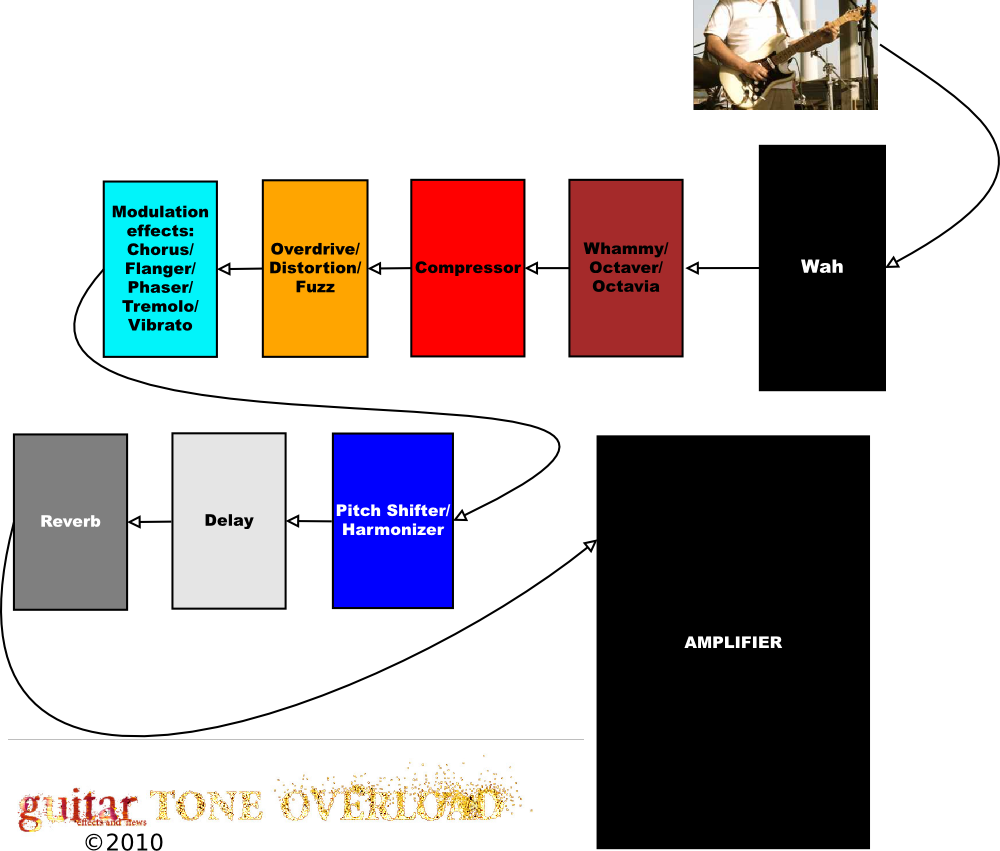
Effect Placement with Whammy bigger

Generic Effect Placement

Remarks:

  • You could argue that the Whammy is a pitch shifter but there are two types of pitch shifters and each type might work better in different places in the chain. You could place a Whammy after your distortion but the “tracking” is usually better before. More sophisticated digital pitch shifters/harmonizers like the Eventide kind sound better after a distortion/overdrive (think Brian May of Queen).
  • Modulation effects like chorus or flanger can be placed before a distortion but the sound will be quite different from when they are placed after. As I said, just experiment!
Case 2: if you own an amplifier equipped with an Effects Loop (a.k.a. FX Loop)

Some effects like delay or reverb sound clearer if they are placed after a distortion/overdrive. In order to use these effects after the natural overdrive of your amp, the amplifier gods created the effects loop. It translates into an “FX LOOP SEND” connector that goes into the “INPUT” of your effect and an “FX LOOP RETURN” connector that goes to the “OUTPUT” of your effect. Here is how it goes:
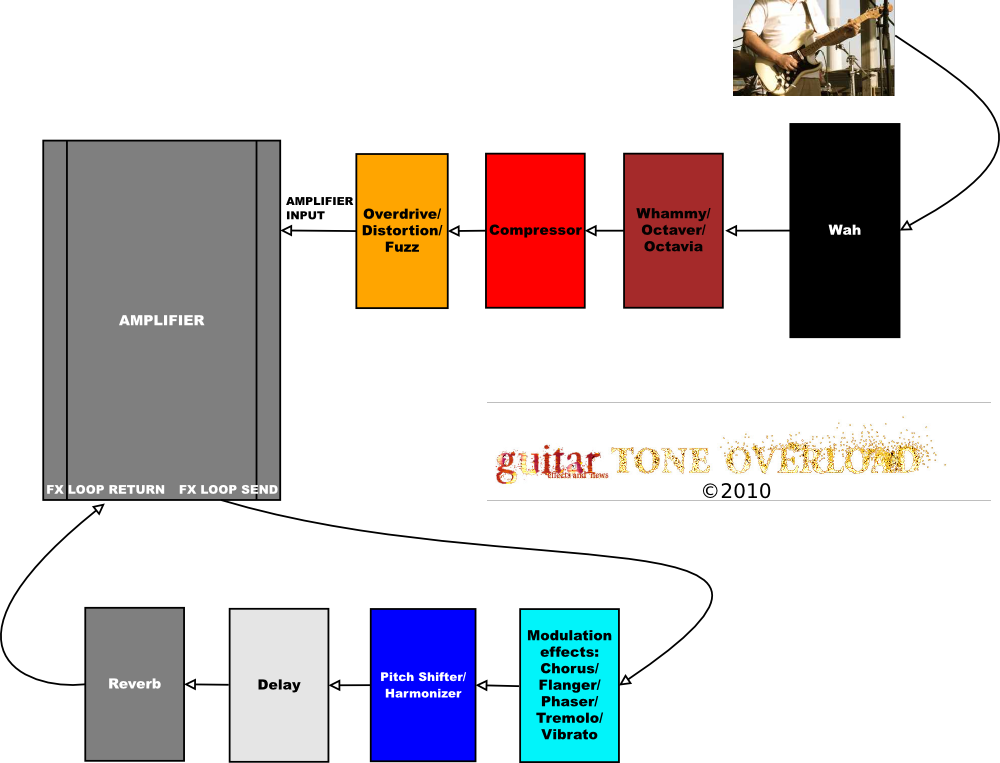
Effect Placement with an FX LOOP

Generic Effect Order and Placement if you have an amplifier with an FX LOOP

Remarks:

The loop is placed in between the two main parts of any amp: the preamp and the power section. Most modern amps get their natural overdrive from the preamp and then the signal goes through the effects loop and is amplified quite cleanly by the power section. Cleanly means that effects like delays and reverb stay “clear”.

This is different from earlier amps which had no master volume let alone effect loops (think old tube Marshall, Fender and VOX amps). With these or their reissues still sold today, in order to get any distortion, you have to crank the volume to make both the preamp and the power section saturate. This is sometimes referred to as “power tube saturation”. Some guitarists like Eric Clapton or Jeff Beck love power tube saturation which explains why they still tend to use older amps that they crank.

To add some “crystal clear” reverb or delay to “power tube saturation”, you can put a microphone in front of the amp and add the effects to the signal picked up by said microphone. Or you can use a power attenuator like the THD Hotplate which can absorb the power of an amp and turn most of it into heat as well as provide a “line level” signal. This can then be used with effects before it has to be re-amplified. Not as easy as an amp with an effects loop or the use of pedals in front of a clean amp! But some guitarists really want the tone provided by “power tube saturation”.
  • Share/Bookmark

BBE Stompware

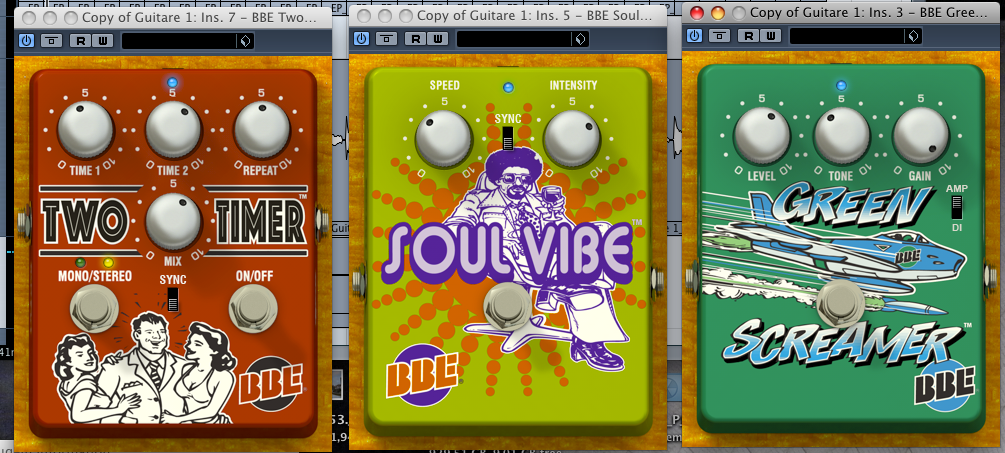
BBE are known for their audio hardware and especially their “sonic maximizer” line of professional studio enhancers. But little is known that they also have a range of guitar pedals which they have just turned into plugins for your favorite recording software. The package is named “BBE Stompware” and provides the following recreations of BBE pedals:

  • Free Fuzz (Vintage ’70s Fuzz)
  • Green Screamer (Vintage Overdrive)
  • Mind Bender (Dual-mode analog vibrato/chorus)
  • Opto Stomp (Vintage Optical Compressor)
  • Sonic Stomp (Sonic Maximizer)
  • Soul Vibe (Vintage Vibe/Rotary)
  • Tremor (Vintage Tremolo)
  • Two Timer (Analog Delay)

Three of the eight effects of the BBE Stompware package

You can use the demo for 15 days without restrictions, I gave it a spin and here is the result using the “Green Screamer”, the “Soul Vibe” and the “Two Timer” Analog delay:

Audio MP3

I used my Stratocaster plugged directly into the audio interface. The “Free Fuzz” and the “Green Screamer” provide some sort of amp emulation making them sound as if they were plugged into an amp.

After my quick tryout, I can say that I am not too impressed with the overdrive and the fuzz but the other effects sound really good especially the “Soul Vibe” and the “Two Timer” analog delay. Who does not love the really lush modulation of a good univibe clone even if I still think my good old pedals sound better.

You can get the demo or a license for the package for a reasonable $149 from Nomad Factory. Note that you will have to authorize the demo. To do so, after installing the software, you must execute a program named “HardDisk Authorizer” which will give you a challenge. You will have to copy and paste the challenge on http://nomadfactory.com/register/demo_reg.html to receive the actual authorization code that you will have to paste on the bottom window of the “HardDisk Authorizer”.

  • Share/Bookmark

Maxon SM-9 Pro+ Super Metal and ST-9 Pro+ Super Tube

In a previous post, I mentioned that Maxon was the company which made the Tube Screamer and other pedals for Ibanez in the 70s/80s. They are now producing pedals under their own brand and they have just released two new models which will bring memories of the past.

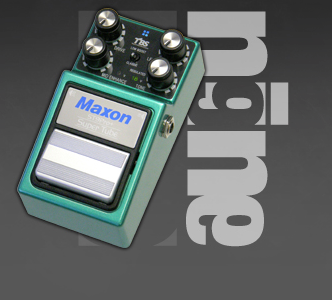
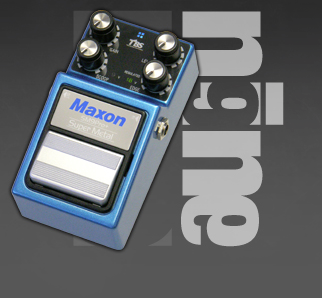
The SM-9 Pro+ Super Metal is not an exact reissue of the 80s Ibanez SM-9. I own an original one and it sports 5 knobs as opposed to the new one which has 4. Also, the 2010 version can be powered with a 9V power supply as well as 18V. In the latter case, it apparently increases “the headroom, frequency range, and dynamic response of the SM-9 pedal”. This new arrival in the Maxon line is clearly geared towards all metal genres, even the most modern, as the sound examples suggest. The old Ibanez SM-9 was also a metal pedal at the time but in an eighties way of course. It was interesting though as it did have some “tube screamer” DNA which does not seem to be the case with the new model.

Maxon SM-9 Pro + circa 2010

The "new" SM-9

As to the ST-9 Pro +, ST stands for “Super Tube” to emphasize its Tube Screamer ancestry, not the fact that it is tube based because it is not.  As with the SM-9, the ST-9 Pro+ is not an exact reissue of the 80s Ibanez model. Maxon claims it is based on the circuit of the good old TS808 Tube Screamer but with added flexibility and more gain options. On top of the usual LEVEL, DRIVE and TONE knobs there is a 4th knob to choose the frequency of the “mid range hump” as well as a switch to choose between a classic tone and a “low boost” tone which will fatten your sound. The ST-9 Pro+ can be powered with a 9V or 18V power supply, the latter mode increasing the “headroom, frequency range, and dynamic response of the” pedal. Listening to the the sound clips, I must say the ST-9 does seem to sound like a super charged Tube Screamer.

Maxon ST-9 Pro +

The ST-9 Pro+ Super Tube

  • Share/Bookmark

Timeless classics: the Big Muff

Question: what do David Gilmour (Pink Floyd), Billy Corgan (Smashing Pumpkins) and Jack White (the White Stripes, The Raconteurs) have in common?

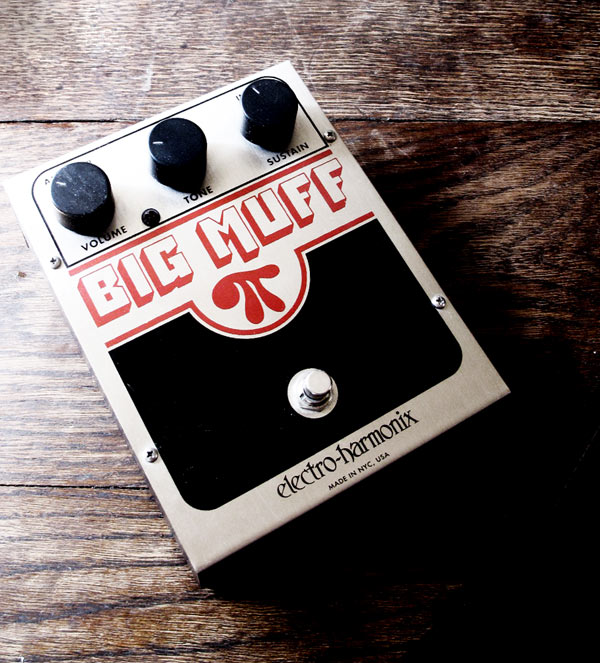
The Big Muff Pi

The Big Muff Pi

Answer: they are all avid users of the Electro-Harmonix Big Muff pedal and a lot of their recordings would not have been the same without the raunchy, dirty, gritty, fat tone of “the muff”. I will demonstrate in two videos the tone of the Big Muff but first, let’s go briefly over the troubled history of this famous distortion pedal.

Short history

The Big Muff originated in the 70s. It is often called a “fuzz” but I rather think it is a distortion pedal as it is quite a departure from the fuzz pedals of the time. Two versions came out in the 70s: the “triangle” Big Muff (triangle because of the shape formed by the knobs) and the “Ram’s head” Big Muff (because there is a little picture of a ram on it).

The maker of the Big Muff, Electro-Harmonix, went bust in 1983. Mike Matthews, its founder, went on to build Big Muff pedals under the Sovtek brand starting in the early 90s (on a side note, Sovtek had a killer line of amps at the time). Electro-Harmonix were “rebooted” later on in the US and they are now very much alive. Their current range of pedals is huge. If you are looking for a brand new Big Muff, you will have to go for the current Big Muff Pi or maybe the little Big Muff which has a smaller casing: those are closest to the “muff tone”. A lot of other pedals currently made by Electro-Harmonix have “Muff” in their names, like the Metal Muff, but they sound quite different from “THE” Big Muff.

The connoisseurs think that the current range of Big Muff is quite inferior sounding to the 70s gear and even to the Sovtek Models. This explains why a number of clones exist like the Ron Sound Hairpie, clone of the US 70s stuff or the Absolutely Analog Green Russian, clone of the Sovtek models. As to the BYOC Beaver, it is a highly regarded kit for you to build your own 70s US Big Muff clone (good luck to get it outside of the US).

If you would like a much more detailed history of the muff, check out this post on Gilmourish. It also tells you which Big Muff version David Gilmour used on the different Pink Floyd albums and tours. You can also visit this awesome site for more details and schematics.

How to get that Big Muff Tone

First of all, let me tell you that the Big Muff is an animal that is difficult to tame. You might try it and think that it sounds really harsh. Know that you really have to use the right amp and will have to play quite loud: don’t think you will get a big smooth tone out of a Big Muff at low volume, especially if you use it on its own.

Used with Humbuckers, the tone goes into “big indie riffage” territory. For this video, I use only the Big Muff with my SG and my little 5W all tube Fender Champ miked with a Shure SM-57 (some reverb was added afterwards in Cubase). The settings on the muff were VOLUME at 10 o’clock, TONE at 10 o’clock and SUSTAIN at 11 o’clock.

The good thing about the Big Muff is that it plays quite well with other pedals. For instance, a compressor placed before will really smooth out the tone whereas an overdrive placed after can remove the relative harshness of the tone, especially at low volume. Use single coil pickups and add a delay to the mix and you might reach the lead tone nirvana, Gilmour style. Here is a video made with a Stratocaster showing the muff interacting with an overdrive or a compressor:

In case you are wondering, the Big Muff I use is a standard current US Big Muff Pi model, no fancy clone or vintage model. As to the Stratocaster, it is a Custom Shop American Classics Stratocaster with Kinman AVn Blues Pickups.

The Settings were as follows:

  • 1974 Fender Silverface Champ (BASS on 10, Treble on 2.5, Volume on 3).
  • Big Muff settings: VOLUME at 10 o’clock, TONE at 10 o’clock and SUSTAIN at 11 o’clock
  • BB Preamp Settings: GAIN at 8 o’clock, VOLUME at 1 o’clock, TREBLE at 12 o’clock, BASS at 2 o’clock
  • Dynacomp settings: OUTPUT at 10 o’clock, SENSITIVITY at 10 o’clock.
  • DD-3 Settings: LEVEL at 10 o’clock, FEEDBACK at 12 o’clock, TIME at 2 o’clock and MODE at 800ms
References


  • Share/Bookmark

What is the difference between a distortion and an overdrive?

I have received some feedback suggesting I should do more “beginner” posts about guitar tone and effects. I have also noticed some interesting questions in the google keywords leading to this site. One grabbed my attention: “What is the difference between the Satchurator and the Ice 9 overdrive?”. These two pedals are designed by VOX in collaboration with Joe Satriani and the answer is: the Satchurator is a distortion whereas the Ice 9 is an overdrive.

So what is the difference between a distortion and an overdrive? To put it simply, an overdrive pedal aims at simulating the creamy sound of an overdriven tube amp whereas a distortion does not try to simulate reality and usually offers more gain and is more aggressive.

ds-1 and ts-9

The BOSS DS-1 distortion (left) and the Ibanez TS-9 Tube Screamer (right)

Way back in the sixties, the only way to get any kind of overdriven tone consisted in just cranking the volume of your tube amp to 10 or 11 if you could. And these amps had no master volume so they were really really loud. Fuzz pedals were the first attempt to reproduce this tone without having to crank your amp. They were really popular in the late sixties but they kind of missed the point and are really a different breed of effect. I will dedicate a post to fuzz pedals very soon!

Later on, talented electronics wizards invented “overdrive” pedals which provided a less harsh tone. Some of them truly approached the singing sound of an overdriven tube amp, so loved by blues and classic rock players. The Ibanez Tube Screamer released in the late 70s is an example of overdrive pedal which became really successful (see my post about it).

Around the same time, other wizards invented distortion pedals which generally offered a raunchier, dirtier, “gainier” tone. The BOSS DS-1 used a lot by Joe Satriani or the Proco Rat are two famous examples.

Then as they did before with fuzz pedals, guitarists combined the tube saturation of their amp with overdrive or distortion pedals, creating entirely new tones… but this is a story for later…

Related Posts with Thumbnails
  • Share/Bookmark